Computing Science Program
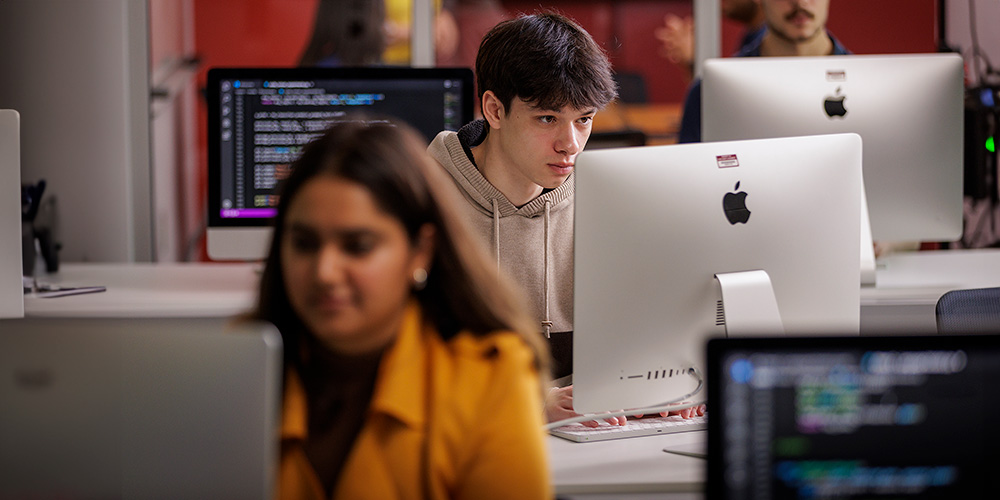
At Saint Mary's you learn how computing works from the ground up: the algorithms, systems and mathematics behind everything from artificial intelligence (AI) and cybersecurity to data, networks and the software the world runs on. It is nationally accredited by the Canadian Information Processing Society (CIPS), and taught in classes small enough that your professors know your name and your work.
Why study Computing Science (CS)?
Computing Science is about understanding problems, finding solutions, and using technology to bring those solutions to life. It combines logical thinking, creativity, and hands-on experience. You will learn how computers work, how to develop software, and how to use data and technology to solve real-world problems. Along the way, you can explore exciting areas such as artificial intelligence and machine learning, cybersecurity, data analytics, computer graphics, mobile and web development, and human-computer interaction. Technology is constantly evolving, but the foundations of computing science remain relevant, giving you the skills and confidence to adapt to new technologies and pursue a wide range of career opportunities.
Why CS foundations matter more in the age of AI
The technologies everyone is talking about today will change, but the ideas behind them last much longer. Take large language models (LLMs), the technology behind AI assistants such as ChatGPT, Claude, Gemini, and Grok, as an example. These systems use artificial intelligence (AI) to understand and generate human language, an area of computing known as natural language processing (NLP). At SMU, you explore these ideas in Artificial Intelligence (CSCI 3482) and Natural Language Processing and Large Language Models (CSCI 4474). Behind these systems are neural networks and machine learning, covered in Machine Learning (CSCI 3470) and other advanced courses (CSCI 4472, CSCI 4478). These technologies depend on data structures and efficient algorithms (CSCI 2341, CSCI 3342, CSCI 4452), which determine how quickly and effectively computers solve problems. They are built using programming languages (CSCI 3430), run on operating systems and computer hardware (CSCI 2327, CSCI 3431, CSCI 3328), and rely on mathematics and the theory of computation (MATH 2301, MATH 1216, MATH 2305, CSCI 2307, CSCI 3451). Together, these foundations help you understand not just how to use today's technology, but how computing systems actually work.
That depth is one of the differences between a university Computing Science degree and a shorter technical program. You will learn to program and work with current tools, but you will also learn the principles that connect algorithms, software, data, hardware and intelligent systems. Languages and platforms will continue to change throughout your career. A strong foundation gives you the ability to learn what comes next, move between technologies and apply your skills to new problems for years to come.
Course codes refer to courses listed in the Saint Mary's University Academic Calendar.
The Saint Mary’s approach
Small classes, and professors who know your work
First-year courses average approximately 60 students. In upper years, most classes hold between ten and twenty. You will take those courses with largely the same group of students across several years, and you will come to know the faculty of the department directly.
This is a practical advantage rather than a soft one. It is the reason students here can raise a research idea in a professor's office and take up a summer research position as a result.
- 10 to 20 students in a typical upper-year class
- Approximately 60 students in an average first-year class
- Three faculty members have received the Father Stewart Medal for teaching excellence
Award-winning teachers who are also working researchers
Three members of the Department of Mathematics and Computing Science have received the Father Stewart Medal, Saint Mary's recognition for excellence in teaching. The same faculty maintain active research programs in machine learning, bioinformatics, complex systems, numerical analysis, computer vision, security and human-computer interaction, and they teach the introductory courses as well as the advanced ones.
A faculty member specialising in natural language processing and large language models has recently joined the department, bringing our newest research area directly into the undergraduate classroom.
- Courses are taught by faculty members.
- Research supervision is available to undergraduate students.
- Ethics modules are being embedded within technical courses, so that privacy, bias and responsible use of AI are treated as part of the engineering work.
Research is open to undergraduates, not reserved for graduate students
Our faculty are active researchers who supervise undergraduates directly. Students are hired onto funded summer projects and complete a full honours thesis under faculty supervision. Their work has been presented at leading international conferences including IEEE/CVF CVPR, WACV and Computational Visual Media, and at regional meetings such as the Science Atlantic Mathematics, Statistics and Computer Science conference.
- Funded summer research. Paid positions on faculty research projects, frequently beginning after second year and continuing across subsequent summers.
- Honours thesis. A year of supervised original research, submitted as a thesis and presented orally (CSCI 4500).
- Teaching and grading assistantships. Upper-year students are employed as teaching and grading assistants in Mathematics and Computing Science courses.
Hands-on learning
Some of our courses include projects for community partners such as Autism Nova Scotia and Northwood. For example, in the Software Engineering capstone, student teams take a system through the full software lifecycle for an external client.
Through the Saint Mary's Entrepreneurial Centre, students can take on paid project work addressing IT challenges for local businesses. Co-operative education is available on both the major and the honours, and our students take part in hackathons and in programming and mathematics competitions at regional, national and international level.
- Community partner capstone. A full-scale build with documentation, testing and handover.
- Paid project work with local organisations through the Entrepreneurial Centre.
- Co-operative education. Paid work terms alternating with study. Interested students should contact the department's Co-op Advisor before the end of first year.
- Competitions and hackathons at regional, national and international level, including programming and mathematics contests.
- Study abroad and exchange through Saint Mary's international partnerships.
Projects our students have worked on
Every year our students build things for real partners. Recent examples:
- Citco Group, global fund administration: a generative AI tool that scrapes documents so fund accountants find information faster.
- Green Power Labs: AI for energy management, from regional solar mapping to site-level integration.
- SimplyCast: mining usage data to redesign interfaces and make the product easier to learn.
- Connect Women’s Centres: interactive dashboards profiling women and girls in rural Nova Scotia.
- Missing Link Technologies: applied research linking data centre infrastructure to AI.
In the department’s own labs, students use an AI server and Light Detection and Ranging (LiDAR) scanner to capture the physical world in 3D for Virtual and Augmented Reality (VR/AR), build explainable AI to predict harmful drug interactions, and construct disease knowledge graphs with graph neural networks. Students have also built fraud detection for a global communications company, a video consultation and e-commerce system for healthcare, and an interface for a music platform connecting DJs and club patrons. Partners vary by term.
Sample courses offered
All students share a common foundation. From second year onward, your upper-year courses are yours to choose, and they tend to group into six directions. These are not formal streams, and you are not asked to declare one: follow a single direction closely, or draw from several.
Artificial intelligence and machine learning
- CSCI 3470 Introduction to Machine Learning
- CSCI 3482 Artificial Intelligence
- CSCI 4472 Deep Learning for Computer Vision
- CSCI 4478 Machine Learning for Graphs
- CSCI 4474 Text Mining and Social Network Analysis
Data and analytics
- CSCI 2227 Introduction to Data Analytics
- CSCI 3461 Database Systems
- CSCI 4480 Big Data Management and Visualization
- CSCI 3380 Information Visualization and Interaction
- CSCI 4479 Introduction to Health Informatics
- CSCI 4430 Complex Networks
Security, networks and cryptography
- CSCI 4301 Systems Security
- CSCI 4423 Cryptography
- CSCI 3421 Data Communications and Networking
Systems and theory
- CSCI 2327 Digital Logic and Computer Architecture
- CSCI 3431 Operating Systems
- CSCI 3451 Theory of Computation
- CSCI 4452 Algorithm Analysis
- CSCI 3430 Principles of Programming Languages
Interaction, graphics and vision
- CSCI 3475 Human Computer Interaction
- CSCI 4471 Computer Graphics
- CSCI 3479 Virtual and Augmented Reality
- CSCI 4476 Digital Image Processing
- CSCI 4472 Deep Learning for Computer Vision
- CSCI 3380 Information Visualization and Interaction
- CSCI 3826 Multimedia Tools and Applications
Building and delivering software
- CSCI 3428 Software Engineering
- CSCI 2356 Mobile App Development
- CSCI 3355 Advanced Internet Technologies and Web Programming
- CSCI 4551 Current Practices in Computing and Data Science
- CSCI 4463 Numerical Software
Some courses appear in more than one direction, because the areas genuinely overlap.
Course offerings vary by term. The Academic Calendar is the authoritative source for course descriptions, prerequisites and availability, and sets out the full requirements for the major, honours, double major, minor, concentration, certificate and co-op options. Students should consult a Program Advisor or Science Advisor when planning their sequence of courses.
Future career opportunities
Halifax supports a working technology sector across ocean technology, health data, financial services, energy and defence. Our students meet those employers before they graduate, through co-op and through applied projects with partners such as Citco, Green Power Labs, SimplyCast and Missing Link Technologies. Our graduates also move into roles elsewhere in Canada and internationally, or directly into research degrees. Example roles include:
- Software developer or software engineer
- Artificial intelligence or machine learning developer
- Data scientist or data analyst
- Cybersecurity analyst
- Systems, cloud or database professional
- User-experience or interactive technology developer
- IT consultant
- Researcher or graduate student
- Founder, or early employee at a start-up
Recent graduates have joined Amazon, IBM Canada, Deloitte, RBC Capital Markets, Ciena, ReelData, Detect Technologies and Posterity Group.
And graduate programs at Georgia Tech, the University of Waterloo, the University of Alberta, the University of Bonn and Saint Mary's University.
And some start their own. While still an undergraduate here, Mr. Smit Kanpariya co-founded Blyyss, a Halifax platform that brings independent and ethnic grocery stores online with deals, flyers and no-markup delivery.
Saint Mary's offers its own MSc in Computing and Data Analytics, so students can continue to graduate study on the same campus, with faculty who already know their work.
What our students are saying
"I came to understand that while curriculum is important, the connection between students and professors can be just as important. This connection became the foundation on which I developed skills like logical thinking and problem-solving, but, perhaps more importantly, the confidence to trust my own reasoning. Whether I was struggling to understand a concept or just wanted to learn more, the door was always open. Every time I thought I had reached the limit of what I could understand, my mentors challenged me to go just a little further, and then a little further again. As a woman in Computing Science, this is particularly valuable."
Diana Proca, BSc Computing Science, Class of 2025
"I was able to work on research projects in the summer after my second and third years and an honours thesis project during my final year, giving me the hands-on research experience and relationships with professors which helped me get into my current Master's program and succeed there. Scholarships and readily available teaching assistant positions were excellent sources of funding, and the campus' location right next to Point Pleasant Park and the ocean was an excellent place to spend four years."
Baxter Madore, Class of 2025, MSc student, University of Alberta
"I completed research on the BRIDGE project applying knowledge graphs to antimicrobial resistance prediction, attended academic conferences, and participated in programming and mathematics competitions. The strong theoretical foundation, research opportunities, and mentorship I received at SMU gave me the confidence and skills to continue tackling challenging problems. One of the most influential experiences for me was taking Number Theory with Dr. John Irving, whose passion for mathematics inspired me to pursue an Honours degree in Computing Science with a Mathematics major."
Yusuff Kazeem, Honours Computing Science with Mathematics, Class of 2025
"I am especially grateful for the opportunity to work as an honours student under the supervision of Prof. Somayeh Kafaie. Her expertise, guidance, and mentorship were invaluable to me. With her support and encouragement, I began my journey as a PhD student, where I now use agent-based modelling to study complex systems. As an international student, I was fortunate to find a supportive community within the department, where ideas were freely shared, and I received encouragement throughout my studies."
Yusreen Shah, BSc 2020, Honours 2023, PhD student, University of Waterloo
"My time at SMU prepared me with a strong foundation for a career in Software Engineering that I am incredibly passionate about. The program provides a solid academic background while incorporating real industry skills. I have since transitioned into a Senior Engineering role at RBC Capital Markets, where I continue to build software that solves complex data problems at scale."
John Yorke, BSc Computing Science, 2024