
Student Resources

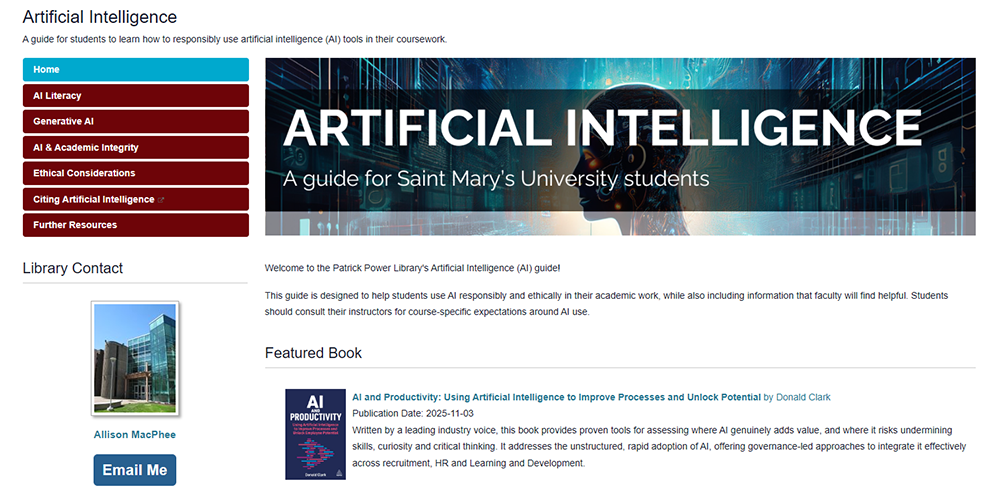
The Patrick Power Library offers a guide to help students learn to use artificial intelligence (AI) tools responsibly in their coursework.
- AI Literacy
- Generative AI
- AI & Academic Integrity
- Ethical Considerations
- Citing Artificial Intelligence
and more.
Patrick Power Library AI Guide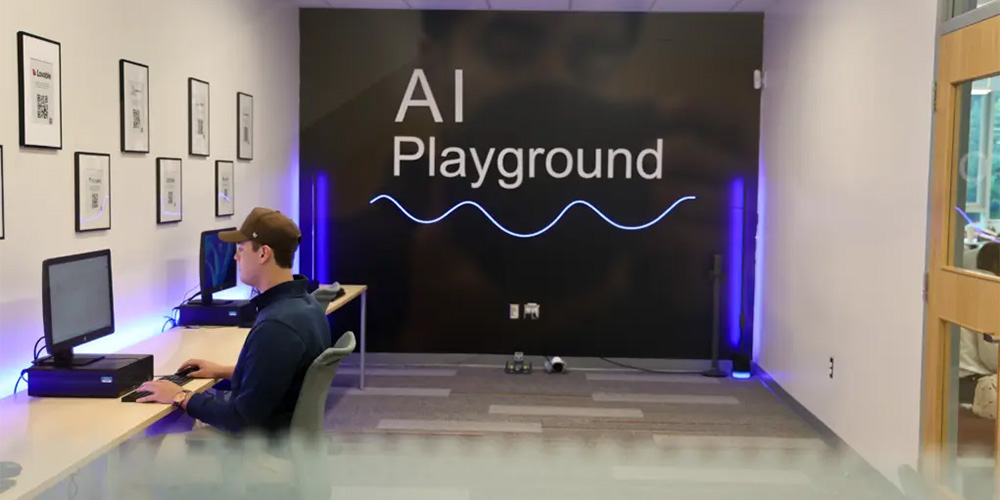
Saint Mary’s AI Playground is a space where students can explore and learn about a variety of AI technologies. The tools in the Playground are provided for experimentation and are not endorsed for exposure to Saint Mary’s data or services. Information entered into these tools may be stored, reused, or exposed according to the provider’s own terms of use and are not subject to Saint Mary’s enterprise data protection.
Have fun... and be careful.
Visit the AI Playground Saint Mary’s AI Playground is a space where students can explore and learn about a variety of AI technologies. The tools in the Playground are provided for experimentation and are not endorsed for exposure to Saint Mary’s data or services. Information entered into these tools may be stored, reused, or exposed according to the provider’s own terms of use and are not subject to Saint Mary’s enterprise data protection.
Have fun... and be careful.
Visit the AI PlaygroundIf you are considering learning more about AI after your undergraduate studies, here are some options:
- Master of Business Analytics (MBAN)
- Master of Science in Computing and Data Analytics (MScCDA)
- Applied Certificate in AI & Analytics for Leaders (upcoming cohorts in 2026)
- Course: CSCI 1826: Exploring Generative AI
If you are considering learning more about AI after your undergraduate studies, here are some options:
- Master of Business Analytics (MBAN)
- Master of Science in Computing and Data Analytics (MScCDA)
- Applied Certificate in AI & Analytics for Leaders (upcoming cohorts in 2026)
- Course: CSCI 1826: Exploring Generative AI
Overview of Generative AI
Artificial Intelligence (AI) refers to computer systems that analyze data, recognize patterns, and generate outputs such as predictions, content, or recommendations. A subset of AI, Generative AI (GenAI), can create text, code, images, and videos, significantly impacting teaching, learning, and assessment.
In higher education around the world, AI is being examined for its potential to be a helpful tool in teaching and learning, while considering its risks to intellectual property, accuracy and critical thinking.
As AI continues to evolve, Saint Mary’s University will remain proactive in balancing innovation with ethical considerations. By implementing thoughtful policies, promoting AI literacy, and ensuring equitable access, we will strive to use AI to improve education while upholding academic standards.
Support for AI
The library maintains an Artificial Intelligence (AI) guide that helps students and faculty use AI responsibly and ethically in their academic work.
- Ask the Husky (self-serve or live chat)
- Call the Help Desk: 902-496-8111
- Visit the Help Desk: Loyola and Atrium in-person Help Desk
- Email the Help Desk: helpdesk@smu.ca
Responsible Use of AI at SMU
SMU has established a set of guidelines to support the responsible use of generative AI in academic work. Developed by the Joint Subcommittee of Academic Integrity, the document is intended to help faculty and students engage with AI ethically, securely, and transparently while maintaining academic integrity.
As a living document, it will be updated regularly to reflect new developments in AI technologies.
SMU Faculty Guidelines on the Use of Generative AI in Courses
We welcome your input. To provide feedback on the guidelines, please email Academic.Regulations@smu.ca.
Key Considerations:
- Use AI tools to enhance, not replace, critical thinking and learning.
- Faculty members determine AI use policies for their courses and must communicate them clearly in course outlines.
- Students must acknowledge and cite AI-generated content appropriately.
- Any misuse of AI in assessments or coursework will be subject to SMU’s academic integrity policies.
AI tools offer valuable opportunities for learning and efficiency, but they also come with ethical responsibilities.
When using AI, consider the following principles:
- Transparency – Clearly disclose when and how AI was used in academic work.
- Integrity – Do not use AI to fabricate data, plagiarize content, or bypass critical thinking.
- Fairness – Be aware of bias in AI outputs and verify information before relying on it.
- Respect for Others – Avoid using AI tools in ways that infringe on privacy, intellectual property, or consent.
Learn more: Ethics of AI Tools (resource coming soon)
AI tools rely on vast datasets, some of which may include copyrighted materials. At SMU:
- University-provided eResources (e.g., databases, journals, audiovisual materials) should not be fed into generative AI tools—even for study or research.
- Faculty, staff and students should review licensing agreements before using third-party content with AI tools.
Be mindful of intellectual property rights:
- Entering unpublished research data, exam questions, or proprietary university content into AI tools could lead to unauthorized disclosure.
- AI platforms may store and reuse prompts to improve their models—review each tool’s privacy settings before use.
Learn more: Patrick Power Library AI Resources
Do not input:
- Personal data (e.g., names, addresses, biometric or medical information).
- Unpublished research or confidential material.
- Commercially sensitive data or intellectual property.
- Culturally significant Indigenous knowledge or restricted materials.
Data Protection Best Practices:
- Opt out of data collection when possible (e.g., turning off chat history in ChatGPT).
- Use university-approved AI tools with enterprise security protections.
Learn more: Patrick Power Library – Privacy & Data Security Guidelines
Proper citation and attribution of AI-generated content is essential.
- Course-specific AI use policies: Faculty will outline expectations for AI use in coursework. Students should follow those expectations and request clarification when required.
- Referencing AI in research: Follow publisher and university guidelines for acknowledging AI-assisted writing or analysis.
Learn more: Patrick Power Library – Citing AI Resources
AI-generated content is not always reliable and may produce inaccurate, biased, or misleading information. Before using AI-generated material:
- Verify sources: AI tools may provide hallucinated citations or outdated data.
- Cross-check with academic resources: Always consult peer-reviewed research, official data sources, and faculty guidance.
- Recognize bias: AI models reflect the biases in their training data; critically evaluate responses.
Learn more: Patrick Power Library – Citations
- SMU discourages reliance on AI detection tools due to privacy concerns, bias, and inconsistent accuracy.
- Faculty are encouraged to design AI-resilient assessments such as:
- In-class exams & discussions
- Process-based assignments with drafts & reflections
- Authentic assessments requiring human reasoning
This external resource is not affiliated with SMU policy. It is provided for reference and broader context.